RunScore
All 3,143 U.S. counties ranked
A county-level index of running culture and physical activity infrastructure.
Luke Popler · Sequoia High School · April 2026

This is RunScore — a measure of running culture built for every U.S. county. All 3,143 of them get a score from 0 to 100, constructed from five public datasets: how active residents are, how many races they organize, how walkable their streets are, and whether the fitness infrastructure to support it all actually exists on the ground.

The question we set out to answer: does a community that runs also live longer, stay healthier, and hold its real estate value better? The answer is yes — and the effect is large enough that a 10-point RunScore advantage predicts $7,885 more in median home value, even after controlling for income.
RunScore is the signal that's missing from every real estate platform. Not walkability. Not school ratings. Whether the people in a community actually move.

RunScore National Map
Geography · National Distribution
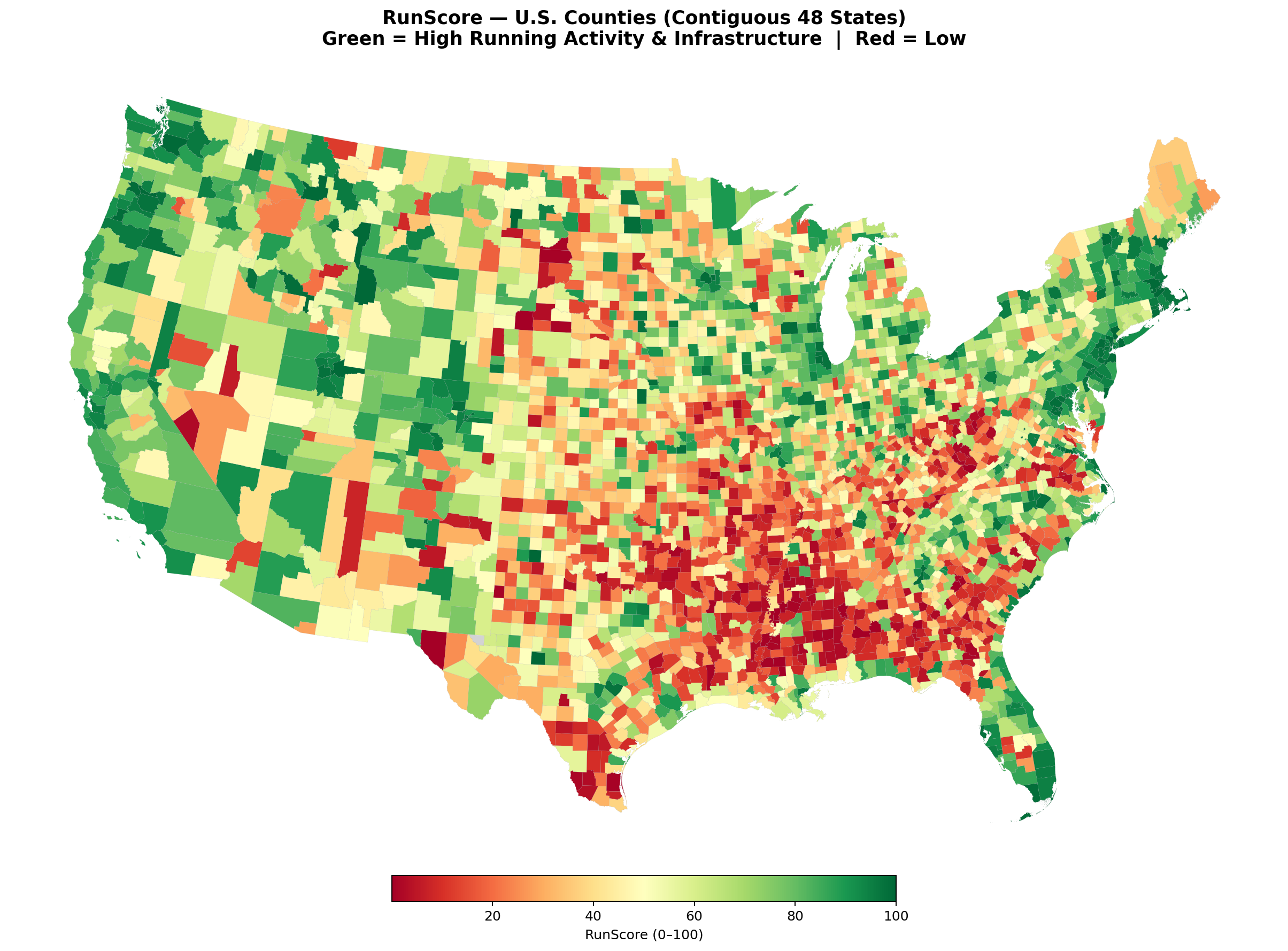
Running culture has a geography — and it is not random
High-RunScore counties cluster in the Northeast corridor (DC, Boston, New York), the Mountain West (MT, WY, CO, UT), the Pacific Northwest, and dense coastal metros. These are places where people have built — and continue to invest in — the conditions for an active lifestyle.

Low-RunScore counties concentrate in the rural Deep South (MS, AL, LA), the Texas Panhandle, and the Northern Great Plains. Physical inactivity rates in these counties often exceed 45–60%. Zero organized races. Near-zero walkability.

Every county gets a score from 0 to 100. A score of 50 is exactly average. The map makes the pattern impossible to miss — running culture isn't spread evenly across the country. It clusters. It has neighbors.
Coverage
FULL NATIONAL
3,143
U.S. counties scored
all 50 states · all urbanicity levels
Home Values
STRONG LINK
+$7,885
extra home value per 10-point RunScore gain
even after accounting for income
Diabetes
STRONG LINK
−1.5 pts
fewer adults with diabetes per 50-point RunScore gain
the strongest health signal in the study
RunScore vs. Obesity Rate
Obesity Rate
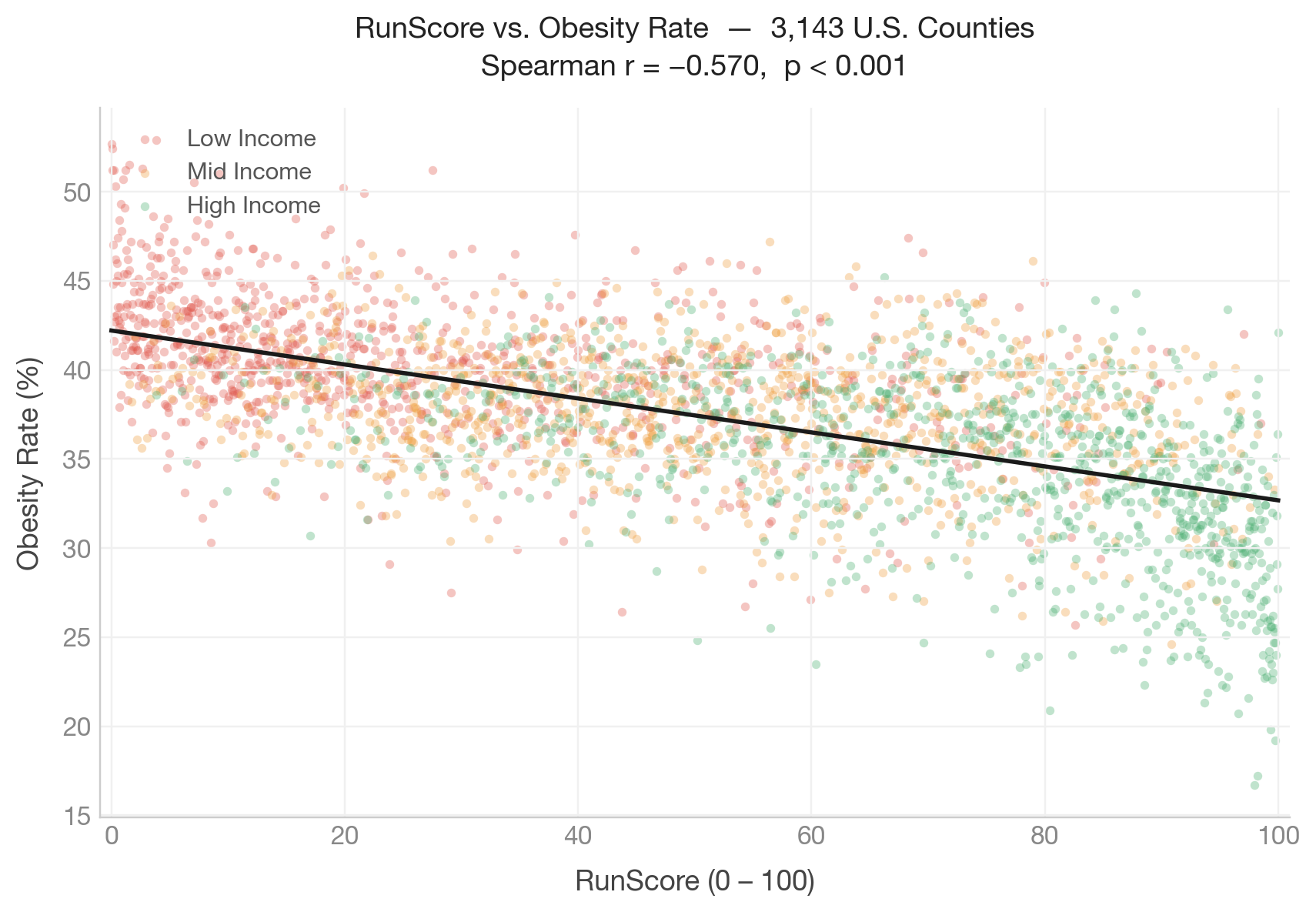
Health  ·  Spearman r = −0.570  ·  p < 0.001
Higher RunScore communities carry less obesity
About 42% of American adults are obese. But that number isn't the same everywhere — and RunScore is one of the clearest predictors of where it's lower. High-RunScore counties consistently have fewer obese residents, and the relationship holds even when you compare counties at the same income level.

In a county with 25,000 adults, moving from a low to a high RunScore is associated with roughly 675 fewer people with obesity. That's not a rounding error — it's a meaningful shift in the health of an entire community.

Wealth isn't the whole story. RunScore picks up something that money alone doesn't buy: a culture where moving is normal, infrastructure exists, and neighbors set the pace.
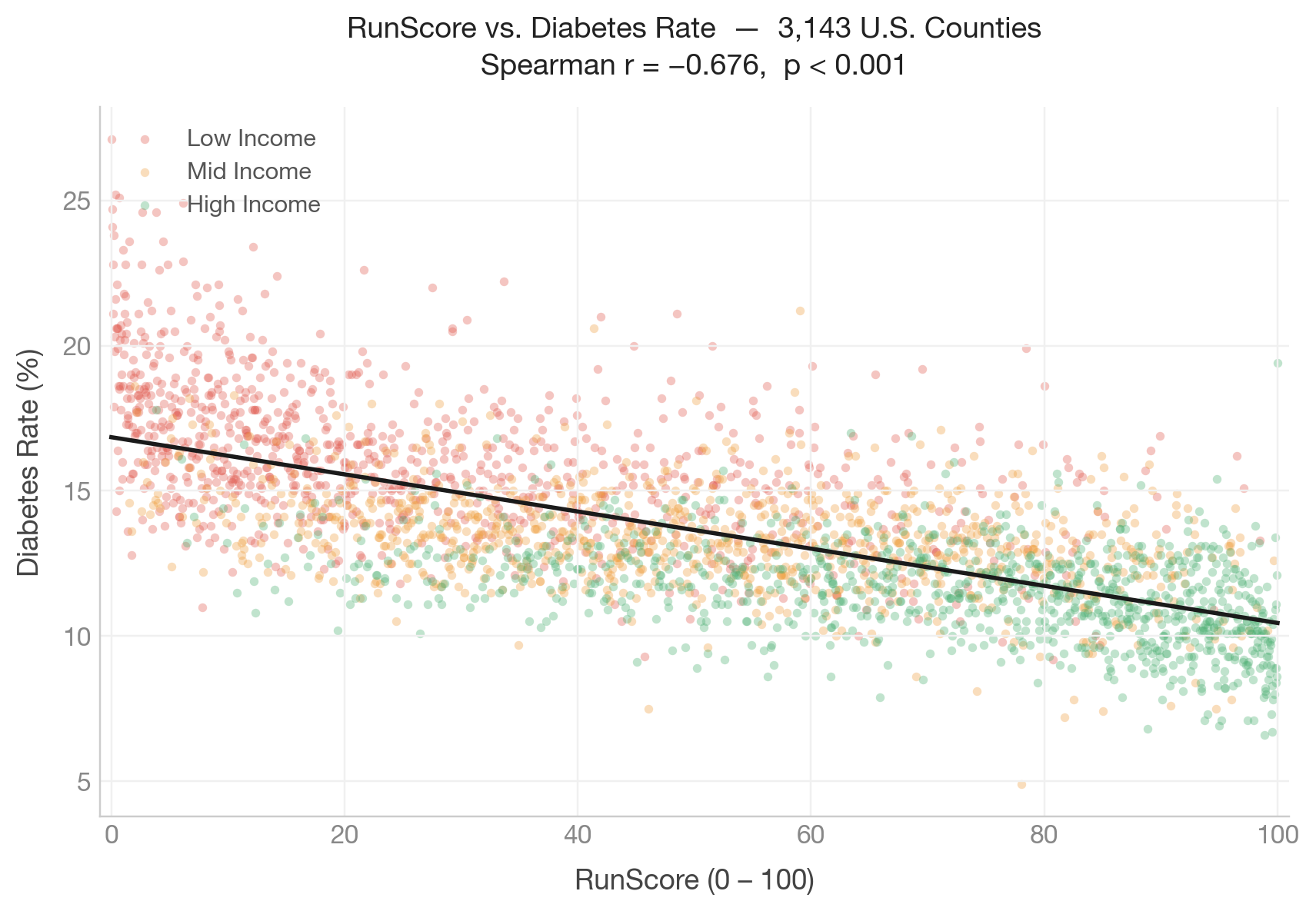
RunScore vs. Diabetes Rate
Diabetes Rate
Health  ·  Spearman r = −0.676  ·  p < 0.001
The strongest health signal in the study
Of all the health outcomes studied, diabetes tracks most closely with RunScore. That makes sense — diabetes is deeply tied to inactivity, and running culture is a direct measure of how active a community actually is, not just how active its residents say they are.

In the lowest-RunScore counties — rural Mississippi and Alabama — more than 1 in 5 adults has diabetes. In high-RunScore mountain communities like Jackson Hole, Wyoming, that drops below 1 in 11. Same country. Vastly different realities.

The gap shows up at every income level. Rich counties with low RunScores still have worse diabetes outcomes than middle-income counties with high RunScores. Running culture does something wealth alone doesn't.
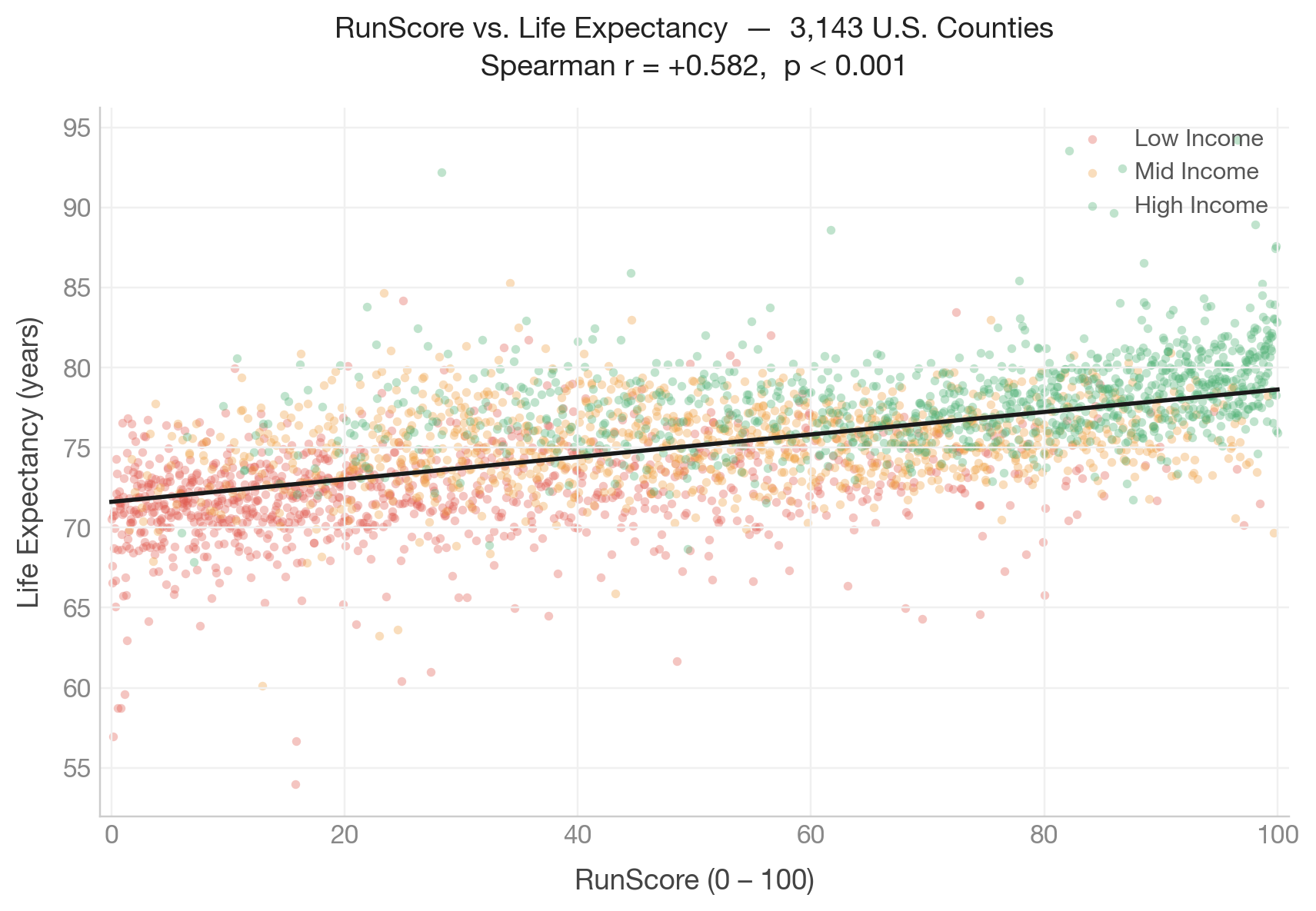
RunScore vs. Life Expectancy
Life Expectancy
Health  ·  Spearman r = +0.582  ·  p < 0.001
People live longer in high-RunScore counties
If all the other health numbers feel abstract, life expectancy doesn't. It's the bottom line — how long do people actually live here? And high-RunScore counties consistently come out ahead, even after accounting for how wealthy or urban a county is.

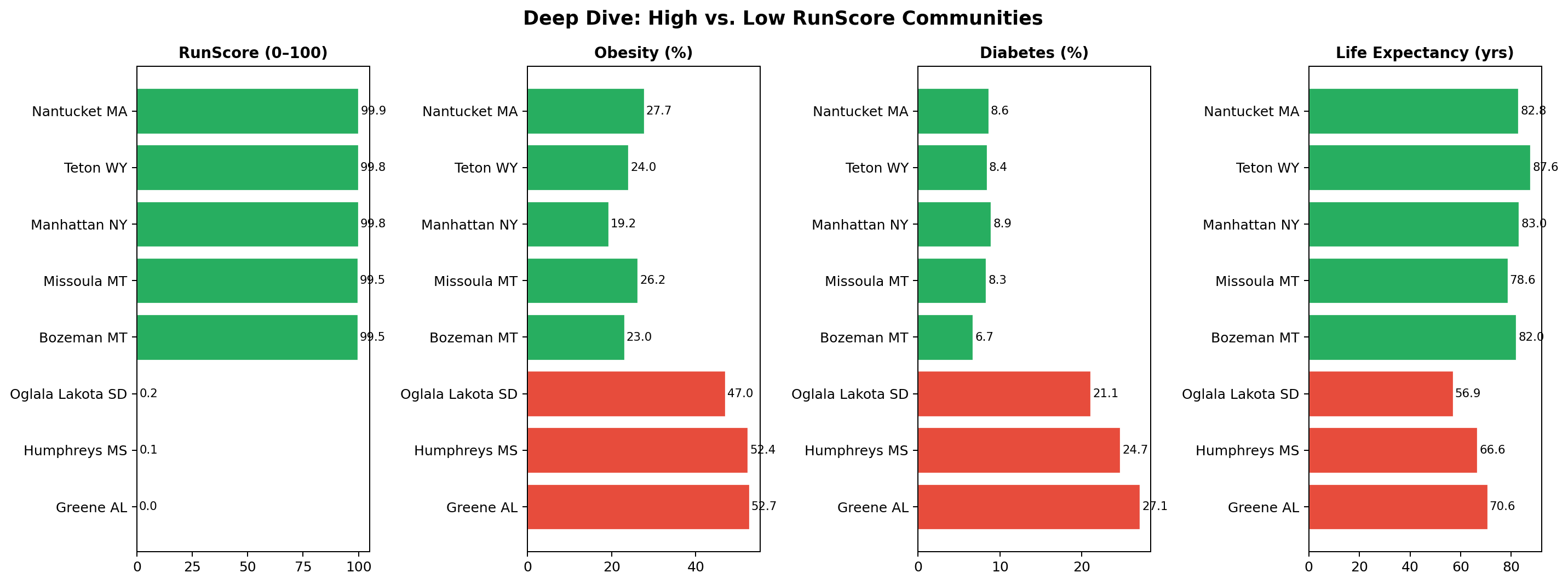
The extremes tell the full story. Teton County, WY (RunScore 99.8) has a life expectancy of 87.6 years — among the longest of any county in the United States. Oglala Lakota County, SD (RunScore 0.2) has a life expectancy of 56.9 years, comparable to some developing nations.

This 30-year gap is not caused by running. But it is measured by RunScore — and RunScore is a way to see that dimension of community wellbeing at national scale.
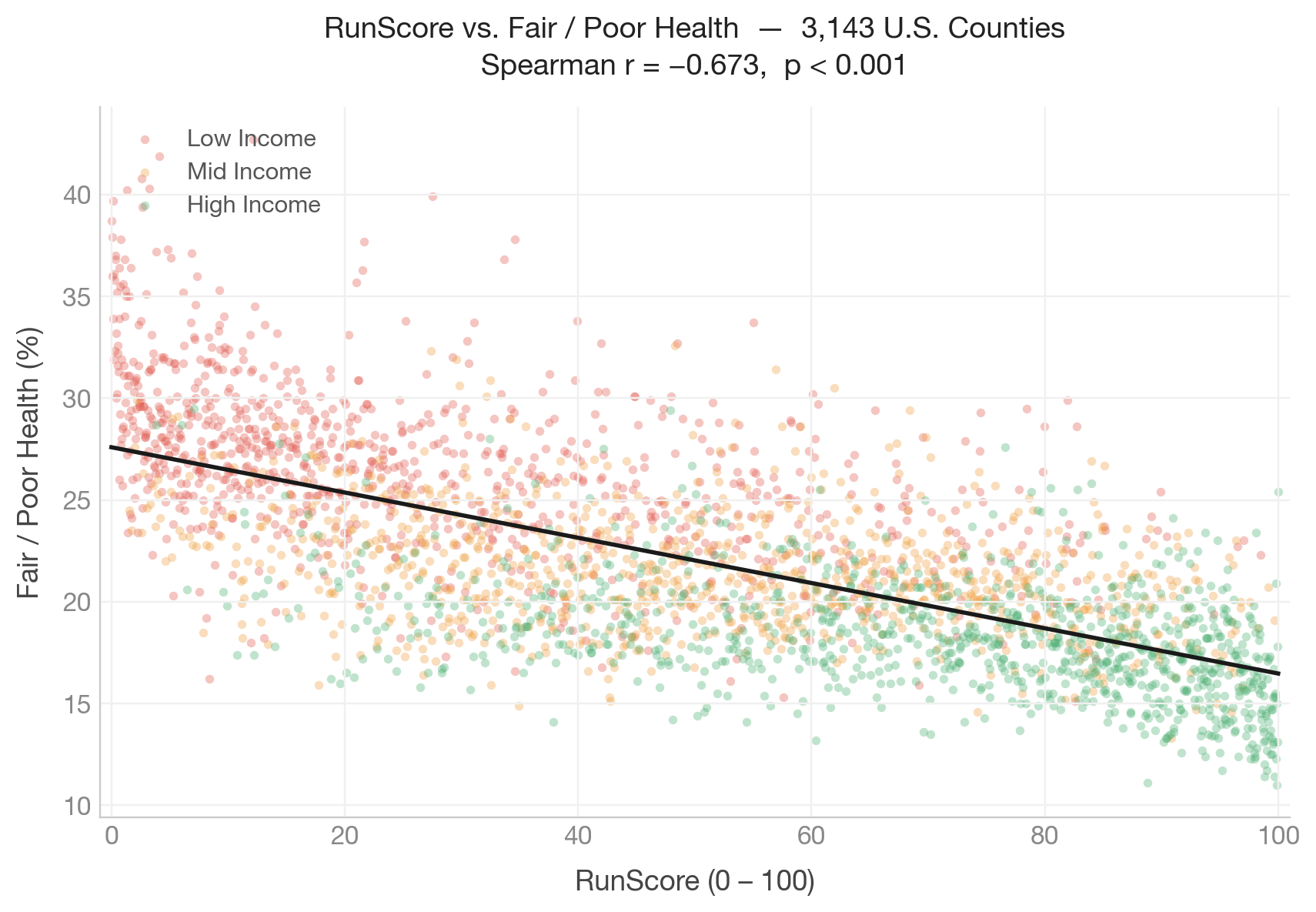
RunScore vs. Fair/Poor Health
Fair / Poor Health
Health  ·  Spearman r = −0.673  ·  p < 0.001
How communities feel about their own health
This one is simple: we asked people how they feel. In low-RunScore counties across the rural Deep South, nearly 1 in 3 adults describes their own health as "fair" or "poor." In high-RunScore communities in the Mountain West and Northeast, that number drops below 1 in 10.

Self-reported health is one of the most reliable predictors of how long someone will live — sometimes more accurate than lab results. A community where people feel healthy is a community where they actually are.

This matters commercially: buyers choosing a community are implicitly choosing a health culture. RunScore makes that culture visible and comparable — across all 3,143 U.S. counties, from a single number.
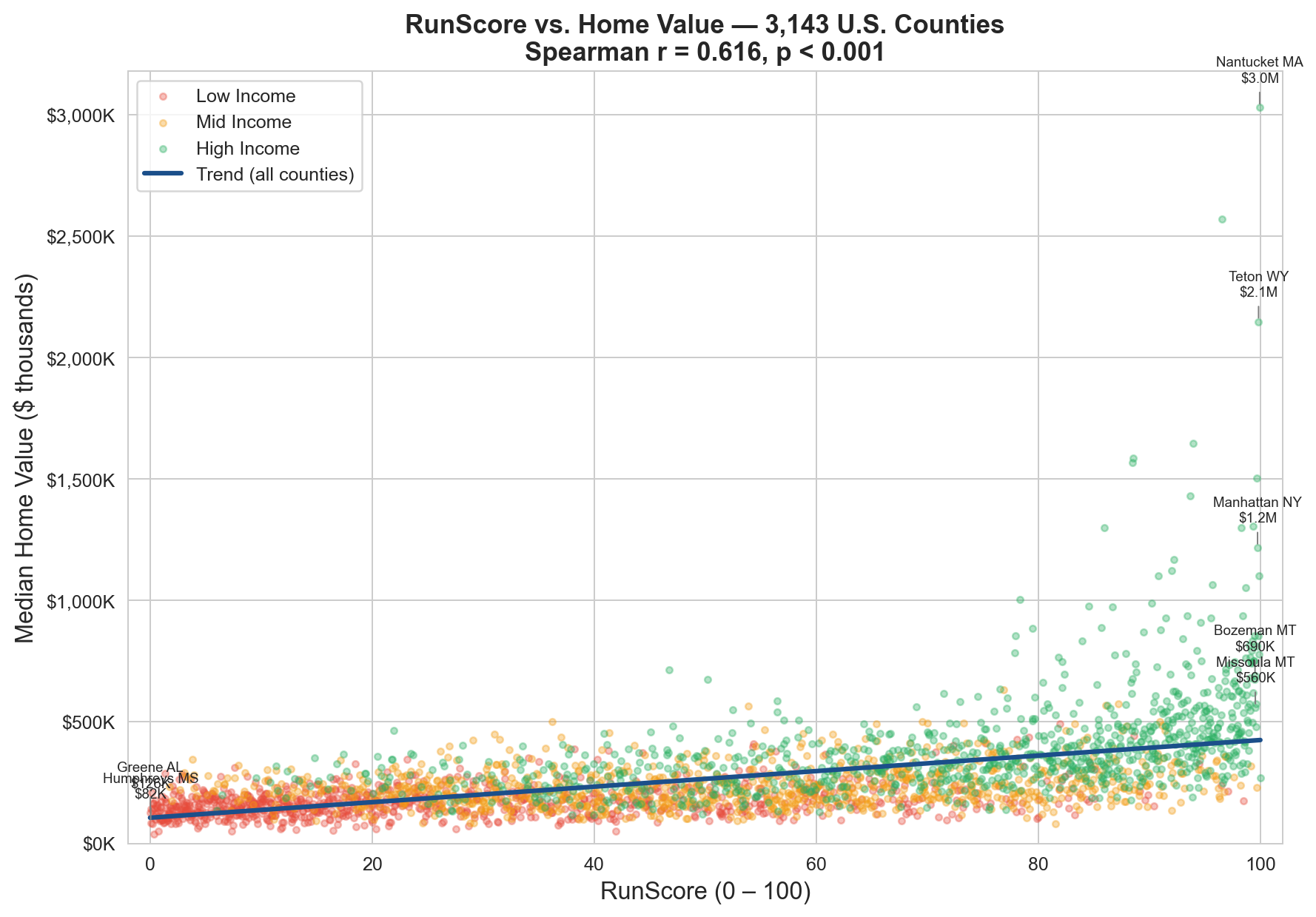
RunScore vs. Home Value
Findings · Real Estate
Homes are worth more in high-RunScore counties — even when income is the same
Two counties. Same median income. The one with a higher RunScore has significantly more valuable homes. That's the core finding — RunScore predicts home prices above and beyond what wealth alone would suggest.

On average, every 10-point jump in RunScore is associated with $7,885 more in home value. Go up 50 points — say, from a car-dependent suburb to a walkable outdoor town — and that gap grows to over $42,000. Same income. Different score. Very different price.

The effect is actually strongest in rural areas — exactly where current real estate platforms have the least to say about lifestyle. In small towns, RunScore does the most work.
5-Year Appreciation Signal
LEADING INDICATOR
+0.9 pts
home value growth over 5 years per 10-point RunScore gain
Strikingly, income barely predicts appreciation — but RunScore does
Rural Advantage
NON-METRO COUNTIES
+0.37%
home value gain per RunScore point in small towns and rural areas
vs. cities — RunScore matters most where other lifestyle data runs out
Community Deep Dive
Community Profiles · Deep Dive
The gap between extremes
Teton County, WY (Jackson Hole) — RunScore 99.8. Life expectancy 87.6 years, the longest in this study. Obesity 24.0%, diabetes 8.4%. Home values $2.1M. Five-year appreciation +67.5%.

Oglala Lakota County, SD — RunScore 0.2. Life expectancy 56.9 years, among the shortest in the United States. Obesity 47.0%, diabetes 21.1%. Zero organized races. Exercise access 1.9%.

The 30-year gap in life expectancy between these two counties is not explained by running. But running culture is one measurable dimension of what separates them — and RunScore is a way to see and compare that dimension at scale, across all 3,143 U.S. counties.
Rankings · Highest RunScore
Top counties
Nantucket, MA
$3,029,344 · 17.2% inactive
99.9
Teton, WY (Jackson Hole)
$2,147,757 · +67.5% 5yr
99.8
New York, NY (Manhattan)
$1,217,413 · 20.4% inactive
99.8
Gallatin, MT (Bozeman)
$689,955 · +31.8% 5yr
99.5
Missoula, MT
$559,508 · income $72k
99.5
King, WA (Seattle)
13.9% inactive · 6.5 races/100k
99.5
Rankings · Lowest RunScore
Bottom counties
Greene, AL
44.7% inactive · 0 races
0.0
Humphreys, MS
47.9% inactive · $82,469
0.1
Oglala Lakota, SD
Life exp: 56.9 yrs · 0 races
0.2
Kenedy, TX
59.8% inactive · 0 races
0.3
Wilkinson, MS
58.2% inactive · 0 races
0.4
Tensas, LA
56.9% inactive · 0 races
0.5
Index
Construction
Five components, one index.
All from publicly available,
annually updated sources.

Five data sources. Each one measures a different piece of what it means for a community to have a running culture. We combine them into a single score — 0 to 100 — so every county in America is comparable on one scale.

  • Physical Activity Level
    What share of adults in a county never exercise in their free time? We flip the number so a higher score means a more active community.
    CDC PLACES 2023
  • Race Event Density
    How many organized road races, trail runs, and marathons happen in a county relative to its population? People who sign up and show up are the clearest signal of a real running community.
    RunSignUp API
    17,810 events
  • Exercise Infrastructure Access
    What share of residents actually have a gym, park, or facility nearby to exercise? Access matters — you can't build a habit around something that isn't there.
    County Health Rankings 2025
  • Fitness Facility Density
    How many gyms and fitness centers exist per person in the county? More facilities means more options, lower barriers, and a stronger culture of physical activity.
    USDA Food Environment Atlas
  • Neighborhood Walkability
    Are the streets safe and connected enough to walk and run outside? The EPA scores every neighborhood in the country — we roll those up to the county level.
    EPA National Walkability Index 2021
Applications · Real Estate Platforms
Built for Zillow-scale integration
RunScore sits alongside Walk Score and school ratings on individual property listings. It captures a dimension none of the existing signals address: whether a community has built the conditions for a physically active lifestyle. Walk Score measures pedestrian convenience. School ratings measure educational outcomes. RunScore measures whether people actually exercise.

All five RunScore components derive from publicly available, annually updated datasets. No proprietary data, no API licensing fees, no survey infrastructure. A platform could compute and publish RunScore for all 3,143 U.S. counties at negligible marginal cost — and update it annually as CDC, EPA, and RunSignUp data refresh.
LISTING BADGE SEARCH FILTER RELOCATION MATCHING APPRECIATION SIGNAL ANNUAL UPDATE NO PROPRIETARY DATA